
Ecommerce Website Design Services In Nagpur
Sell products online through a fast, mobile-friendly ecommerce website designed to support product discovery, customer trust, secure transactions, and long-term business growth.
Whether you operate a retail store, manufacturing business, educational product platform, or direct-to-consumer brand, your ecommerce website should make it easier for customers to browse products, place orders, and complete purchases.
- ✓ Mobile Friendly Shopping Experience
- ✓ Secure Payment Integration
- ✓ WooCommerce Powered
- ✓ Conversion Focused
- ✓ Easy Product Management
What Is Ecommerce Website Design?
Ecommerce website design involves planning, designing, and developing online stores that allow businesses to showcase products, manage inventory, process payments, and fulfill customer orders through a secure digital platform.
An ecommerce website combines product architecture, user experience design, mobile responsiveness, payment processing, and conversion optimization to help businesses sell products online efficiently.
Product Presentation
Displaying products clean-visually with high-resolution images, detailed catalogs, variations, and simple pricing matrices.
Shopping Experience
Optimizing store layouts, navigation menus, product search bars, and filtering paths so customers find items in seconds.
Secure Transactions
Integrating SSL certificates, merchant accounts, and gateway APIs (UPI, Razorpay, cards) for security-focused payment and SSL configuration.
Store Management
Configuring inventory controls, sales status updates, automatic invoices, and client dashboards.
Included Benefits:
Key Components Of An Ecommerce Website
A successful online store requires seamless interaction between multiple frontend client pages and backend database models:
Product Catalog Structure
Logical category pathways and search filters that allow buyers to locate items within seconds.
Product Pages
Conversion-optimized product layouts displaying images, pricing, specifications, and direct cart actions.
Shopping Cart
A persistent, bug-free shopping cart overlaying screen margins to summarize chosen items and pricing.
Checkout Experience
A streamlined, single-page checkout flow minimizing input steps and cart abandonment rates.
Payment Processing
Securely integrated payment gateways (Razorpay, UPI, cards) for immediate digital transaction clearance.
Order Management
A backend dashboard for store owners to track order statuses, generate invoices, and manage client details.
Why Ecommerce Websites Matter For Modern Businesses
Transitioning to a digital storefront unlocks critical advantages that allow your enterprise to grow without physical constraints:
Sell Products Beyond Business Hours
Allow customers to browse and purchase products at any time of day, creating a 24/7 sales pipeline.
Expand Beyond Local Markets
Reach customers outside your immediate Nagpur service area, expanding your brand across regions.
Improve Customer Convenience
Provide a streamlined mobile shopping and checkout experience that adapts to any screen or smartphone.
Support Marketing Campaigns
Create high-converting landing destinations for paid Google Ads, Meta Ads, and email marketing promotions.
Who Needs An Ecommerce Website?
We construct tailored database catalog setups and cart layouts for various product business models:
Retail Businesses
Sell products directly to customers online, bypassing physical foot traffic constraints.
Manufacturers
Accept inquiries and product bulk orders digitally with custom corporate sitemaps.
Wholesalers
Display complete product catalogs and manage bulk pricing or account registrations.
Educational Product Sellers
Offer books, courses, study kits, and educational materials to students and institutions.
Direct-To-Consumer Brands
Control the entire customer purchasing experience, from initial discovery to delivery.
Educational Institutions Selling Products
Sell school/college books, study materials, student uniforms, digital learning resources, and certificates through a unified campus store.
Common Ecommerce Challenges Businesses Face
Without a structured digital commerce consultant, online stores frequently encounter barriers that block conversion rates:
Low Online Sales
Slow page load speeds, confusing navigation, or lack of trust-building elements lead to low visitor conversion rates.
Difficult Product Management
Outdated content systems make it hard to update inventory, add categories, or manage product variations manually.
Poor Mobile Shopping Experience
Store pages and checkout buttons that shrink or break on mobile screens frustrate users and increase drop-offs.
Complicated Checkout Process
Too many checkout fields or missing local payment integrations (like Razorpay, UPI) cause buyers to abandon their carts.
Limited Product Visibility
Search engines struggle to crawl and rank individual product pages without clean URLs or proper schema markup.
Types Of Ecommerce Websites We Build
From simple product indexes to advanced custom hybrid booking channels, we build digital storefronts focused on transactions security:
WooCommerce Stores
Custom, highly scalable WordPress storefronts tailored for retail, wholesale, and D2C brands.
Businesses seeking complete ownership of their website data with greater control over platform ownership and recurring software costs.
Product Catalog Websites
Informational online catalogs that display products and specifications without active payment processing.
Wholesalers, manufacturers, and B2B distributors seeking quote requests or catalog browsing.
Multi-Category Ecommerce Stores
Storefronts carrying diverse inventories across multiple categories with advanced filtering.
Local department shops, gaming platforms, or retail brands managing extensive product lines.
Service + Product Hybrid Websites
A unified platform offering service bookings alongside physical or digital product sales.
Clinics selling wellness kits, academies selling courses, or agencies selling templates.
Features Included In Every Ecommerce Website
We integrate essential user controls and backend tools to support a confident go-live:
Product Management
Easily add, edit, or delete items, prices, and imagery without developer help.
Category Structure
Clean menus and nested groups that divide inventories into logical sections.
Secure Checkout
SSL-encrypted checkout pages that protect buyers' credit cards and UPI credentials.
Payment Gateway Integration
Native setups connecting Razorpay, Cashfree, Stripe, or direct bank accounts.
Inventory Management
Automated stock tracking triggers alerts when product volumes slip below limits.
Order Tracking
Direct dashboard pathways for buyers to view order progress and courier states.
Mobile Optimization
Fluid product grids and touch-optimized checkout fields built mobile-first.
Search Functionality
An active predictive search bar that retrieves correct listings in milliseconds.
Product Filtering
User-friendly sidebars sorting products by pricing, ratings, sizes, or colors.
Customer Contact Forms
Dedicated forms for customized bulk quotes or product inquiries.
SEO Foundations
Clean sitemaps, microdata tag layouts, and optimized meta descriptions on products.
Speed Optimization
Compressed image systems and light database loads to secure fast rendering.
Ecommerce Website Case Studies
Verify how we design clean visual online storefronts and speed-optimized checkouts:
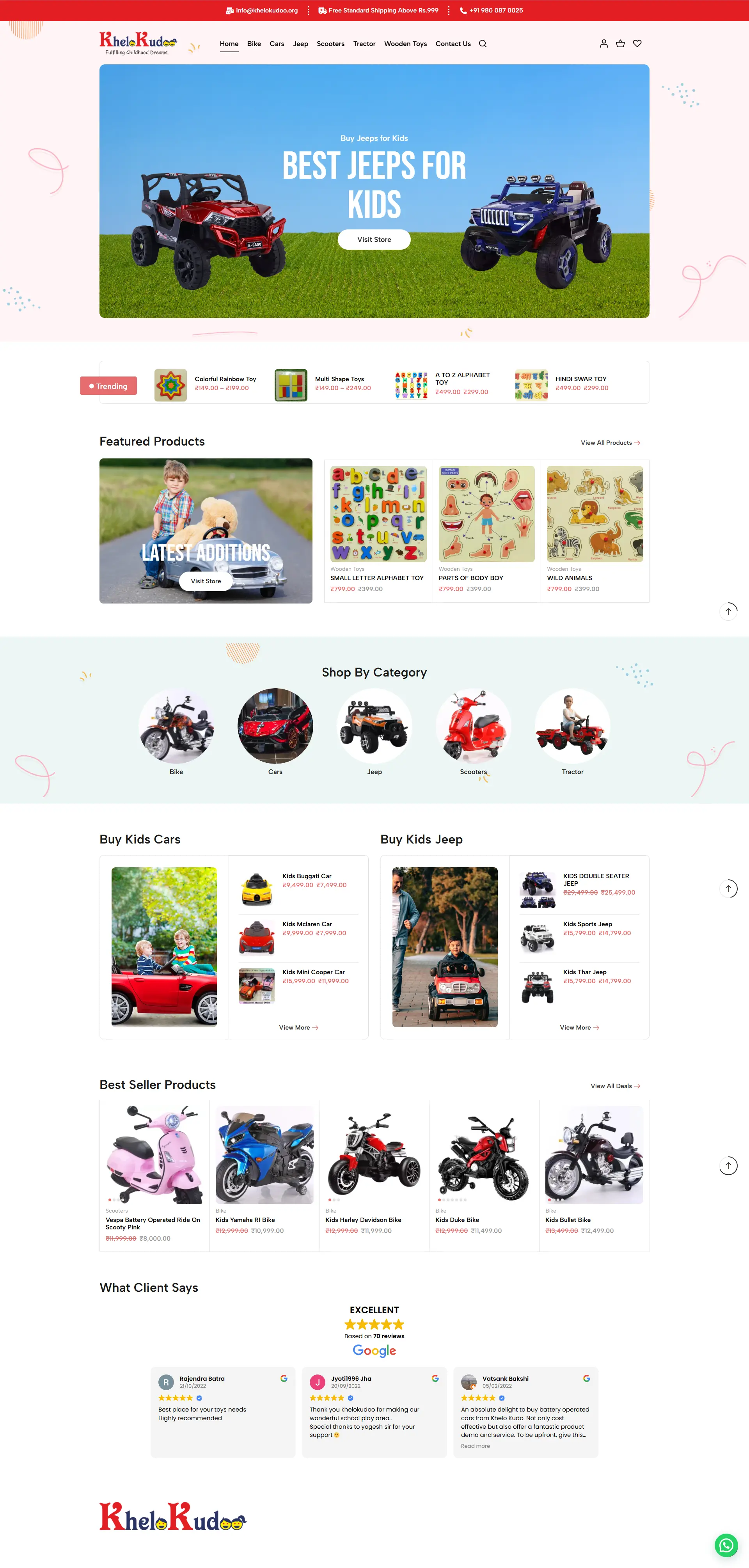
KheloKudo
Present products clearly and simplify online purchasing.
Structured product categories and mobile-first shopping experience.
Improved product discoverability and purchasing convenience.
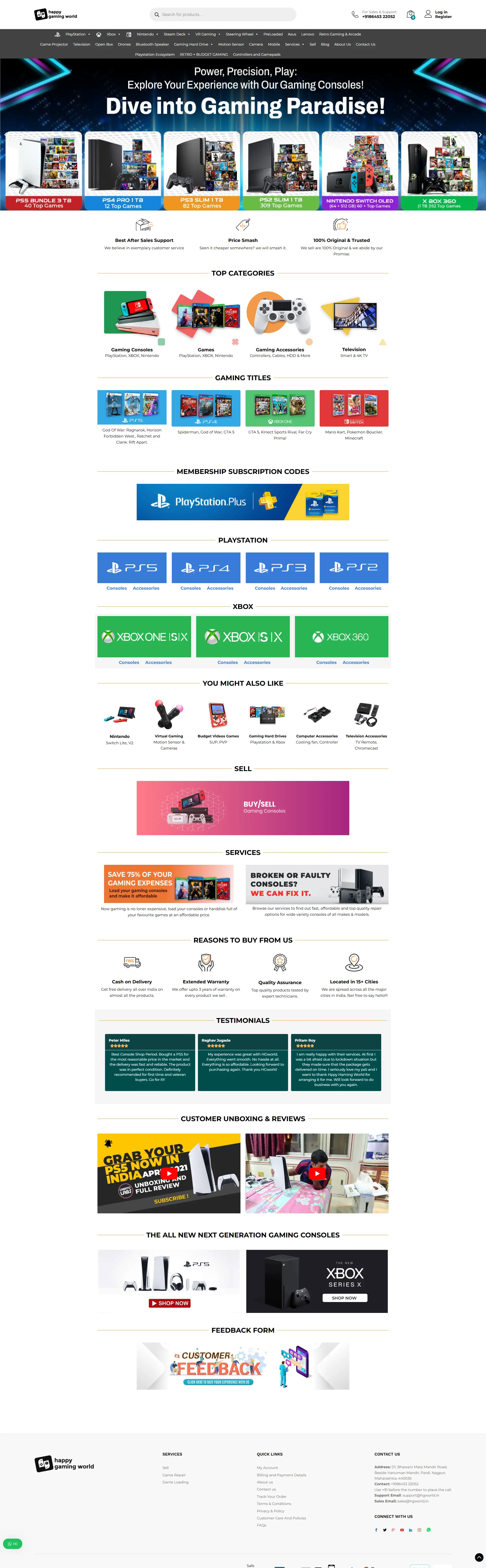
Happy Gaming World
Display gaming products and services in an organized format.
Modern ecommerce structure and simplified navigation.
Better user experience and clearer product journeys.
Planning An Ecommerce Store?
Request A Free Ecommerce Audit
Get recommendations for store structure, product organization, mobile shopping experience, and checkout optimization.
Our Ecommerce Website Design Process
We guide your store planning variables through five structural process steps to optimize checkout speed:
Store Planning
Analyzing store user flows, listing transaction requirements, and finalizing sitemaps pattern.
Product Architecture
Reorganizing sitemaps, mapping nested category trees, and structuring initial product parameters.
Design & Development
Building conversion-optimized frontend store themes and connecting WooCommerce modules.
Payment Integration
Setting up secure merchant bank links, SSL security certifications, and API transactional loops.
Testing & Launch
Running full cart validation runs, checking loading latency parameters, and deploying live configurations.
How Ecommerce Websites Support Business Growth
A properly structured online catalog improves customer reach and supports continuous digital scale:
Sell Products 24/7
Allow customers to place orders around the clock, converting off-hour traffic automatically.
Expand Beyond Nagpur
Direct advertising and localized search targets globally to capture buyers outside Nagpur.
Increase Mobile Orders
Provide checkout pathways on mobile devices to remove friction and boost user loyalty.
Improve Search Rank
Proper search layouts and indexing ensure specific catalog models are found on search engines.
Support Ads Traffic
Host customized paid ad landing destinations with complete analytics transaction tracking.
Download The Ecommerce Website Planning Checklist
Map your database catalogs and payment pathways securely before launching. Our blueprint contains:
Ecommerce Website Cost Factors
Every ecommerce project is unique. Project complexity depends on product volume, integrations, store functionality, and operational requirements.
We review category sizes, payment configurations, and shipping routing to outline a transparent, custom project estimate.
Request A Project EstimateThe cost of ecommerce website design depends on:
- ✓ Total product index volume and category counts
- ✓ Functionality requirements (wholesale portals, custom product builders)
- ✓ Third-party integrations (ERP syncs, shipping aggregators, CRMs)
- ✓ Product variation complexity (dynamic pricing, size/color arrays)
- ✓ Bespoke design custom layouts vs modular configurations
Project Types & Scope Architectures
Starter Store
Use Case: Ideal for local retailers and small businesses launching online sales with an initial inventory.
- 10–50 products catalog
- Standard payment gateway integration
- Essential shopping cart workflows
- Mobile-friendly checkout pages
Growth Store
Use Case: Designed for growing brands expanding their online footprint and syncing inventory tracking.
- 50–500 products catalog
- Automated inventory tracking layers
- Dynamic product variation matrices
- Multiple payment integration nodes
Advanced Ecommerce
Use Case: Bespoke digital commerce platform built for wholesale, large distributors, or massive inventory sellers.
- Large product inventories (500+ items)
- Bespoke ERP/accounting synchronization
- Dynamic B2B bulk wholesale pricing
- Custom payment and shipping routing
Related Website Design Services
Explore additional custom web design and engineering resources tailored to support your organization online:
WordPress Website Design
Bespoke WordPress site design using speed-optimized block architectures built for business growth.
Website Redesign
Strategic redesign services focused on performance, accessibility, speed, and conversion updates.
Landing Page Design
Standalone lead capture landing page architectures built to maximize Google and Meta ad traffic.
Website Maintenance
Weekly plugin updates, cloud backups, security scans, and database calibrations.
Related Website Challenges
Ecommerce checkout paths are highly sensitive to user experience bottlenecks. Explore how we diagnose and solve these issues:
Slow Website
Learn how slow-loading pages lead to higher cart abandonment rates and lower search visibility.
Poor Mobile Experience
Examine how unoptimized shopping carts and viewports prevent smartphone purchases.
Website Security Issues
Understand how vulnerabilities and transaction failures compromise customer trust.
Frequently Asked Questions About Ecommerce Website Design
Common queries regarding catalog database migration, merchant gateways setup, shop variables, and project scoping.
How much does an ecommerce website cost?
Project costs depend on business goals, functionality requirements, content scope, integrations, and overall project complexity. Every project begins with a consultation or audit to determine the most suitable solution.
Should I use WooCommerce or Shopify?
We recommend WooCommerce for businesses seeking complete data ownership, customization freedom, and no recurring platform listing fees. We evaluate this choice based on your team size and ERP demands.
Can I manage products myself?
Yes. Every storefront is built with an easy-to-use admin panel. You can add new products, edit descriptions, adjust pricing, and track inventory variables without writing any code.
Can customers pay online?
Absolutely. We securely integrate payment gateways like Razorpay, Cashfree, or Stripe, allowing your customers to pay instantly via UPI (GPay, PhonePe), credit cards, debit cards, or net banking.
Will my ecommerce website work on mobile devices?
Yes. Mobile responsiveness is standard. All catalogs, product variations, carts, and checkout pages are optimized mobile-first to support a smooth shopping experience on smart devices.
Can I add products later?
Yes. The database structures are built with architecture designed to support significant catalogue growth. You can add hundreds of categories and thousands of products as your inventory grows over time.
How long does an ecommerce website project take?
Starter e-commerce setups require 3 to 4 weeks. Advanced corporate storefronts and massive inventory platforms take 6 to 10 weeks depending on catalog preparation and API setups.
Can ecommerce websites rank on Google?
Yes. We deploy e-commerce sites with clean HTML sitemaps, product schema microdata, structured category pages, and fast load speeds to ensure maximum organic search engine rankings.
Do you provide ecommerce website maintenance?
Yes. We offer continuous support packages covering database optimizations, security patches, merchant gateway upgrades, and routine backups. View our maintenance service details.
Which payment gateways can be integrated?
We primarily integrate UPI-compatible aggregators like Razorpay, PayU, and Cashfree for local Indian payments, and Stripe or PayPal for international credit and multi-currency transactions.
Can an ecommerce website support WhatsApp orders?
Yes. Ecommerce websites can integrate WhatsApp enquiry and ordering workflows, allowing customers to ask questions or place orders directly through WhatsApp.
Ecommerce Website Design Services Across Nagpur
We serve manufacturers, retailers, local brands, and product agencies across major Nagpur neighborhoods including Ramdaspeth, Dharampeth, Civil Lines, Sadar, Laxmi Nagar, and Manish Nagar to help grow online businesses.
Retail Businesses
Helping local retail shops transition their physical products catalog online to reach customers across Nagpur.
Manufacturers
Developing bulk catalog sitemaps and corporate inquiry configurations for industrial manufacturers and distributors.
Local Brands
Crafting premium direct-to-consumer store layouts for Nagpur product brands looking to grow their sales channels.
Product-Based Businesses
Setting up optimized WooCommerce setups for distributors, coaching centers, and product hubs serving local buyers.
Request A Free Ecommerce Website Audit
Struggling to convert traffic or manage inventories on your current online store?
Request a free website audit. Your website will be reviewed your catalog layouts, checkout experience, and mobile shopping configuration, sending you a custom recommendation report.
- ✓ Store Structure Review
- ✓ Product Architecture Analysis
- ✓ Mobile Shopping Review
- ✓ Conversion Review
- ✓ SEO Review
Audit Request Submitted
Thank you! Your submission is being reviewed your URL performance. Your customized video audit and sitemap roadmap will be sent to your email shortly.
Ready To Launch Your Online Store?
Whether you are launching a new ecommerce business or upgrading an existing online store, a properly planned ecommerce website can improve product visibility, customer experience, and long-term growth.